Our Identity
At the youth level of football, we could have the best quarterback, the fastest running back, and the most athletic wide receivers in the league — but none of that matters if we can’t block. Everything starts up front.
Our offensive philosophy is simple: identify and play the kids who give us the best chance to move the ball through their blocking ability. That includes linemen, sure — but also wide receivers who block on the edge, running backs who protect the ball and follow blocks with purpose, and even quarterbacks who sell fakes and execute the play with discipline.
We are a run-first offense, not because it’s safe, but because it builds toughness and confidence. We don’t need to get cute to move the football — we need to be sound, physical, and relentless. At the youth level, the teams that block better usually win. We don’t reinvent the wheel — we build it stronger.
We focus on the fundamentals: pad level, hand placement, footwork, leverage, and timing. We rep these things every day because we know they’re what separate a good offense from a great one.
We will strive to be perfect, and even if we fail, we’ll still be great.
That’s our mindset. We chase perfection not for style points, but because greatness is built on discipline and execution. Everything we do — from our play design to our personnel choices — reflects that belief.
Blocking Schemes
Youth Football Online has a great article on picking an offense to run for youth football coaches. Additionally it does a great job of breaking down different offenses by age/grade.
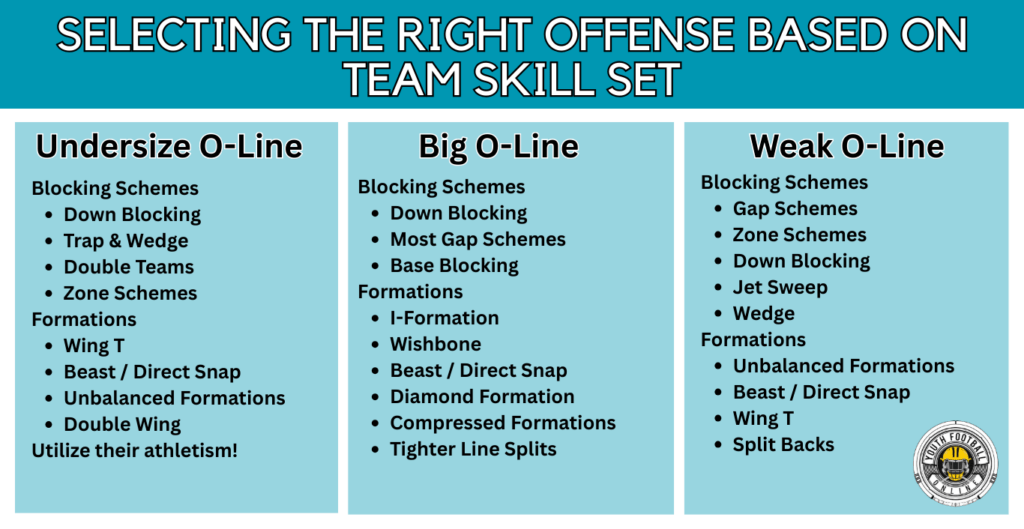
This image from YFO in my opinion is gold. Additionally in my experience of everyteam I’ve coached OLine has always been weak and needs to be a area of focus.
Before a Formation can be determined a blocking scheme must be selected first and the following sections are based on what to run when you have a weak O-Line
I personally keep my most athletic lineman as guards because they will be asked to pull
Gap Scheme
The gap scheme is about moving bodies. It’s about physicality, double teams, and down blocks to open up a specific hole. You’re not blocking a man — you’re blocking an area or a gap.
Blocking Rule: GOD — Gap, On, Down
IF there’s a defender in your play side gap,
→ THEN block him. (GAP)ELSE IF there’s a defender directly on you (head up),
→ THEN block him. (ON)ELSE
→ Block down — help your teammate by taking the next inside defender. (DOWN)
How to explain it:
“We use something called GOD blocking — it helps you figure out who to block. First, look in the gap inside of you. If someone’s there, boom — block him. No one? Block the guy right in front of you. Still no one? Turn and help your buddy by blocking the next guy down.”
Key coaching points:
- Use the GOD rule before every play to ID your assignment.
- Block down on the defender in the gap inside of you.
- The backside guard or tackle pulls around and leads through the hole.
- Great for plays like Power or Counter.
Example play:
On Power Right, the left guard pulls and leads through the right side hole (usually off-tackle), while everyone else blocks down to the inside.
Great For:
- Power
- Counter
Special Rule for Beast Formation:
Beast Formation Blocking Rule:
👉 Down block across the board.
In Beast, we keep it simple and smash-mouth. Everyone blocks down to create a wall on the play side. No pulling, no reads — just wall off the defense and drive them inside while our ball carrier hammers the edge or hits the wedge.
Zone Scheme
“Zone blocking is about teamwork and movement. Everyone steps the same way and blocks the first man that shows in their zone. We want to create running lanes by getting defenders moving sideways.”
How to explain it to 9-year-olds:
“Pretend you’re in a marching band. All five of you step the same direction at the same time. If a defender shows up in your zone, you block him. If not, keep moving to the next level.”
Key coaching points:
- Everyone steps in the same direction (inside or outside zone).
- Double teams at the line with plans to climb to linebackers.
- The running back reads the flow and chooses the best gap.
Example play:
Outside Zone Left – Everyone steps left, working to seal defenders to the inside or push them sideways. The RB finds the crease.
Down Blocking
Down blocking is a core part of the gap scheme. It’s what we often do when we get to the D in our GOD rule. Each lineman blocks the defender lined up inside of them — usually at an angle. It’s about sealing the inside so we can run off tackle.
How to explain it to 9-year-olds:
If there’s no one in the gap or right in front of you, then look down inside and help your teammate. You’re going to block at an angle and push your guy back or across the field. This helps us run outside where the hole is
Key coaching points:
- Step inside at an angle with a strong base.
- Get your head across and drive through the defender.
- Work together — your block might help two teammates.
Great for: Power, Counter, Trap — anything where you want to wall off the defense.
Jet Sweep
“The Jet Sweep gets your speed on the edge fast. Timing is key. The line’s job is to reach and seal defenders to the inside while the runner flies across the formation.”
How to explain it to 9-year-olds:
“Our fast guy is going to run sideways behind the QB and take the ball in full sprint. You linemen need to be quick, step sideways, and keep the defenders from chasing him down.”
Blocking tips for the O-line:
- Front side: Reach block — get outside the defender and turn him in.
- Back side: Cut off pursuit — don’t let defenders chase the play down from behind.
- Playside guard and tackle are the most important — they’ve got to move their feet!
Add a WR crack block from the outside to help seal the edge and spring a big play.
Formations
Here are some of the formations I’ve found the most success with at the youth level.
Beast

The Beast Formation is a power-heavy, unbalanced formation often used in youth football—especially with younger age groups (6U–10U). It’s designed to overwhelm the defense with numbers and power, making it ideal for short-yardage, goal-line, or teams with one dominant runner.
You might have noticed in the diagram above that we like to move our weakside tackle next our strong side tackle and bring in the weakside receiver to the line. We don’t hide what we are trying to do. We are going to overwhelm a side and hit it hard.
What Makes It Effective:
Perfect for wedge, power, Sweep, or quarterback sneak plays.
Tons of blockers in tight space. Kids don’t have to learn complicated schemes—just block straight ahead or to the edge.
Wing T

🦅 The Wing T Formation
The Wing T is one of the most versatile and time-tested formations in football. While it’s used at every level—from youth to high school to college—it really shines in youth football because it creates misdirection, angles, and leverage, which can confuse even well-coached defenses.
The base look includes a tight end (Y), two running backs (a fullback and a wing (Z)), and one wide receiver (X) who can line up wide or tight, usually in a balanced or unbalanced alignment. The wingback, who lines up just off the tight end, is the key to the whole thing—he can motion, block, or take the ball on a sweep or counter.
💡 Why We Use It:
We love the Wing T because it gives us options.
From the same exact look, we can run:
- Power
- Counter
- Jet/Rocket Sweep
- Play Action Boot
That means the defense doesn’t know what’s coming—even if we line up in the same formation every time.
🔨 What Makes It Effective for youth:
- Misdirection wins at this age. Defenses chase motion and ball movement. Wing T takes advantage of that.
- Natural double teams and angles. Our down blocks and pullers don’t have to be perfect technicians—just aggressive and disciplined.
- Play-action built-in. As soon as we’ve run power or sweep a few times, we can fake it and bootleg behind the flow.
- Motion helps diagnose the defense. If defenders chase the motion, we can come back the other way. If they stay home, we hit the edge.
🔁 How We Teach It:
We line up in a Wing Right look most of the time:
- TE and Wing on the right side
- Fullback in a 3-point stance behind the QB
- Backside RB aligned behind the tackle
We’ll flip it depending on who we want carrying the ball or where the mismatch is.
Our base plays are:
- Power
- Jet Sweep
- Counter
- Trap
- Play Action Bootleg
Spread Formation
Spread Formation (With Motion to Wing)

The Spread Formation is our balanced, wide-open look. It’s designed to stretch the defense horizontally and vertically, making it easier to find running lanes and create space for quick passes, jet sweeps, and QB runs.
Even though it looks like a “pass-first” formation, we use it to run the ball, create motion mismatches, and get our athletes in space. It’s still youth football—we just dress it up with a more modern look.
This formation gives us options — motion, RPO-style looks, inside zone, QB keepers, and Jet Sweep — while still being simple enough for 9U to execute. It spreads the defense out and lets us see how they react.
We also use shifts from Spread to Bunch formations to force defenses to communicate and adjust on the fly. By starting in a wide 2×2 look and then shifting one or more receivers into a tight Bunch set, we create confusion, natural picks, and leverage for the run or quick passes. It’s a simple pre-snap movement that gives us a numbers advantage, especially against youth defenses that struggle to adjust quickly.
If defenders spread with our WRs? We run inside.
If they stay tight? We get the ball outside fast.
If they don’t adjust to motion? We exploit it.
 Tactical Youth Football Coaching